

Somewhere between 2023 and today, "we're building AI" became the default answer to every business transformation question. Board decks full of GPT integrations. Hackathon demos that drew applause. Slack channels renamed to #ai-taskforce. And then, for most companies, a quiet nothing. The demo stays a demo. The initiative gets deprioritized. The engineers move on.
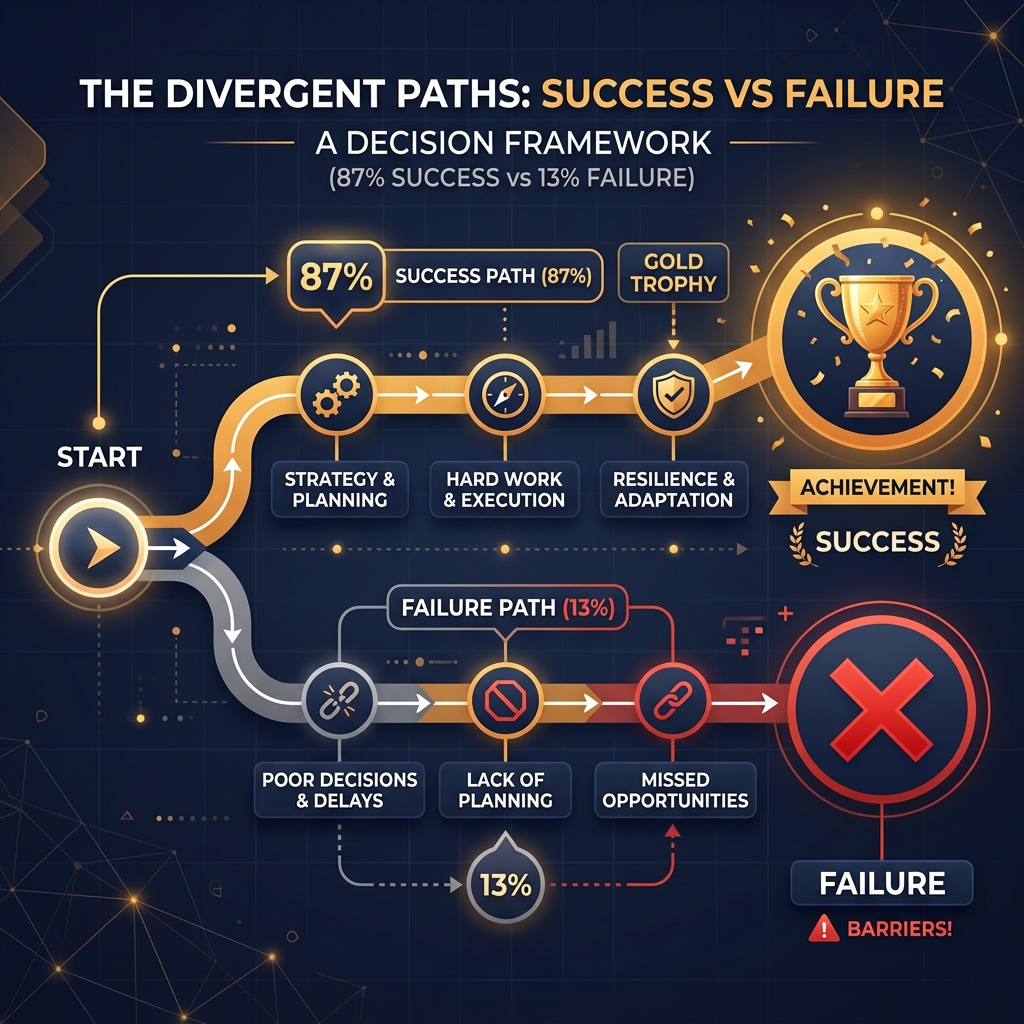
About 80% of enterprises have now adopted AI in some form. Only around 13% report meaningful business impact from it. That's the real story of AI in 2026 — not the adoption rate, but the deployment gap. And that gap has a name: demo purgatory.
This is the guide for teams who want to get out of it — or never end up there in the first place. We'll walk through what AI development actually requires in 2026, what separates the 13% that ship from the 87% that don't, and the framework we use to push AI products from whiteboard to production.
Why Most AI Projects Die Between Demo and Production
The pattern is almost always the same. A team gets excited about a model. They build something impressive in a constrained environment with good data, happy paths, and curated prompts. Leadership loves it. Budget gets approved. Then the project gets handed to an engineering team, scaled up to real data and real users, and quietly falls apart over the next six months.
What went wrong? Usually all of the following, at once:
No use-case discipline. The most exciting demos are rarely the most valuable use cases. The question isn't "what can this AI do?" — it's "where does this AI replace the most expensive, highest-volume manual work we currently do?" Teams that skip this question build impressive demos for use cases nobody needs at scale.
No evaluation harness. When the demo breaks in production, there's no way to tell why, no way to measure whether fixes helped, and no way to prevent regressions when the next change ships. Shipping an LLM feature without automated evals is like deploying a web app with no monitoring — you'll find out something's broken when a user complains.
Architecture not designed for production. Demos run on clean inputs, fixed prompts, and no rate limits. Production means thousands of concurrent users, unexpected inputs, the model's API going down on a Friday night, costs you didn't model, and latency that's fine in the office but painful on a mobile connection. Almost none of that shows up in a demo.
No cost model. Token costs compound in ways that are easy to underestimate. A support bot handling 100,000 queries a month, with a 4,000-token average context, on a premium model, can burn $40K a month. Projects that didn't measure this upfront either die quietly when the CFO asks questions, or get cut to something too small to matter.
The Framework: Five Things the 13% Do Differently
After working across enough AI projects to see the patterns clearly, here's what separates the teams that ship from the teams that prototype:
They start with a use case, not a model. The first question is never "which model should we use?" It's "what problem are we solving, what does success look like, and can we measure it?" Concretely: what's the input, what's the desired output, what's the volume, what's the cost of getting it wrong? If you can't answer those before picking a model, you're not ready to build.
They build evaluation before they build features. Before writing a single integration, the 13% define a golden test set — 50 to 200 real input/output pairs representing what good looks like. Every subsequent change gets scored against it. You can't iterate on something you can't measure, and "this feels better" is not a measurement.
They pick the model for their actual data. Not benchmarks. Not press releases. Not whatever's trending. They take their top three model candidates, run them against their real inputs, measure accuracy and latency and cost on their specific task, and choose based on that. The model that wins a coding benchmark might lose badly on your domain-specific document extraction. Benchmarks are proxies. Your data is the truth.
They design for observability from day one. Every call through the AI layer produces a trace: what went in, what was retrieved, what prompt ran, what came out, how long it took, what it cost. Without that, you're debugging blind. With it, you can find the one prompt variant causing 40% of failures within hours of it appearing.
They keep humans in the loop — deliberately. The strongest AI products don't try to replace humans in every case. They automate the high-volume, clear-intent cases and route the ambiguous, high-stakes, or emotionally sensitive ones to humans with full context. This makes the AI more trustworthy, the product more reliable, and the system easier to improve over time.
Choosing the Right Type of AI for Your Problem
Not every AI problem needs the same solution. Teams often overcomplicate (reaching for fine-tuned models when a prompt would do) or undershoot (using simple rules when the problem genuinely needs a neural approach). Here's a quick map:
Retrieval-Augmented Generation (RAG) — when you need an LLM to answer questions about your own data (documents, policies, product catalogs, support history). This is the right first choice for roughly 70% of enterprise AI projects. Faster to build than fine-tuning, cheaper, and easier to update.
LLM prompting + function calling — when you need the AI to take actions (call APIs, query databases, run workflows) based on natural-language input. Copilots, agents, chatbots that actually do things. Stack this on top of RAG when the use case needs both knowledge and action.
Fine-tuning — when you need to change how a model responds (its tone, its format, its domain-specific vocabulary) rather than what it knows. Rarely the right first move. Usually the right third or fourth move, once you've proven the use case works with prompting.
Computer vision / specialized models — when the input is images, video, or audio rather than text. Quality control in manufacturing, medical image analysis, document processing, biometric systems. A different stack than LLM work, though the product discipline is identical.
Classical ML / predictive models — when you have a defined, measurable outcome and structured historical data. Churn prediction, demand forecasting, fraud scoring, price optimization. Often overlooked in the LLM era, but still the most reliable tool for structured prediction problems.
What AI Development Actually Costs to Do Right
Budgets for AI projects fail in both directions. Some teams drastically underestimate (figuring a few API keys and a Python script is all they need). Others drastically overestimate (building massive MLOps platforms for use cases that warrant a well-crafted RAG pipeline and a webhook).
A useful breakdown of where the money actually goes in a serious AI product engagement:
Discovery and scoping (10–15%). Use case definition, data audit, technical feasibility, success metric definition. Teams that skip this spend it later — multiplied by ten — debugging the wrong thing.
Data and retrieval infrastructure (20–30%). Cleaning data, building pipelines, chunking and embedding documents, setting up vector databases, building the retrieval layer. This is where most AI projects discover their data is messier than they thought.
Model integration and prompt engineering (15–20%). Selecting the model, writing system prompts, designing the conversation flow, building tool calls and function integrations. Iterative. Requires the eval harness to do properly.
Evaluation framework (10–15%). Building the golden dataset, writing automated eval scripts, setting up regression testing. This is the investment that makes everything else maintainable.
Production engineering (20–25%). API routing, auth, rate limiting, caching, cost tracking, logging, fallbacks, deployment. The boring stuff that determines whether you have a product or a demo.
Ongoing iteration (continuous). AI products aren't done when they ship. Models improve, failure patterns emerge, users find edge cases, accuracy drifts. Budget for a continuous improvement cycle or accept degrading quality.
How We Build AI Products at Codewingz
We're a product studio, not a research lab. Everything we build is intended to ship, run in production, and generate measurable business outcomes. Our AI development process reflects that:
We start every AI engagement with a two-week discovery sprint — use case analysis, data audit, eval set definition, and an honest conversation about whether the problem actually warrants an AI solution or if something simpler would work better. If the answer is "no," we say so before anyone's committed six months of budget.
From there we follow a tight loop: build the retrieval or model layer, test against the eval set, ship to a limited internal environment, measure against real inputs, iterate. We don't demo to stakeholders until the eval numbers meet the target threshold. This prevents the "wow in the boardroom, broken in the field" failure mode.
We build all AI work with observability as a first-class requirement — full traces, cost dashboards, accuracy tracking, and alerting on regression. When something breaks (and it will), we want to find it in our dashboards, not in a customer complaint.
If you're starting an AI project and want to get the scoping right from the beginning, explore our AI development services or book a discovery call.
The Bottom Line
The $391 billion in enterprise AI spending in 2026 will mostly go to projects that don't generate meaningful returns. Not because AI doesn't work — it clearly does, for the 13% that build it correctly. But because most teams optimize for the demo, not the deployment.
The framework is actually simple: define a high-value use case before touching a model, build evaluation before building features, choose the model for your data not the hype cycle, design for observability from day one, and keep humans in the loop where it matters. Do those five things and your project has a real shot at being in the 13%.
Everything else — the model choice, the framework, the cloud provider — is secondary. The discipline is the differentiator.
Ready to build AI that actually ships?
We'll help you find the right use case, define the spec, and build it to production standards.
Get a Free Consultation