

The first wave of generative AI adoption was a press release wave. Companies announced their "AI-powered" features, their GPT integrations, their copilots and assistants and creative suites. Investors nodded. Boards felt reassured. And mostly, underneath the announcements, nothing changed in the actual numbers.
That wave is over. We're now in the reckoning phase — where companies that built real GenAI workflows are lapping the ones that built announcements. Global spending on generative AI reached $644 billion in 2025. The market is projected to hit $1.3 trillion by 2032. That's not hype money. That's operational investment from organizations that found actual ROI and doubled down.
This article is about what those organizations actually built. What GenAI looks like when it moves from the demo environment to the quarterly P&L. And what the development process looks like for teams trying to get there without burning twelve months on something nobody will use.
The "GenAI Is on Our Roadmap" Trap
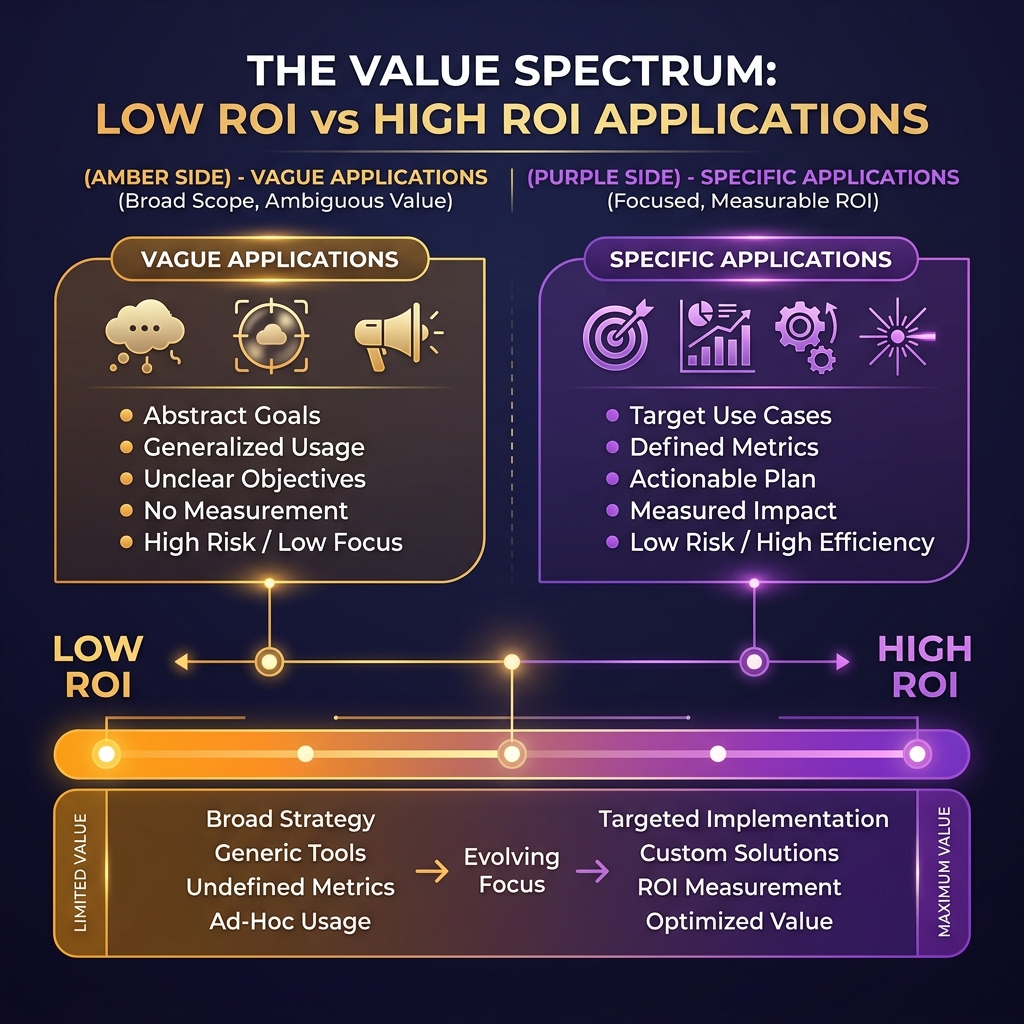
There's a specific kind of AI project that sounds great in planning and produces nothing measurable eighteen months later. It goes like this: a team identifies a broad area where GenAI "could help" — content creation, customer experience, internal knowledge management — builds a flexible platform to support many use cases, and ships something that covers a lot of ground at shallow depth.
The problem isn't the technology. It's the framing. "AI for content" is not a use case. "Auto-generating the 90,000 product descriptions we need for our EU expansion, each tailored to local search behavior, validated against brand guidelines, and output as structured JSON for our CMS" is a use case. One of these has a scope, a success metric, a cost model, and a clear owner. The other has a roadmap bullet.
The GenAI projects that move the P&L are almost always uncomfortably specific. That specificity isn't a failure of ambition. It's a sign that someone did the hard work of defining what success actually looks like before writing a line of code.
Where Generative AI Is Actually Generating Value in 2026
Across the organizations that are finding real returns, a few use-case patterns keep appearing. They share three characteristics: high volume (the task happens hundreds of times per day), clear brief (the input/output structure is defined and verifiable), and measurable outcome (you know what "correct" looks like).
Structured content at scale. Product descriptions, listing copy, localized variants, personalized outreach. An e-commerce company with 50,000 SKUs and a manual copywriting team spends roughly $180K a year writing product descriptions that average 150 words each. A GenAI pipeline with validated output and brand guardrails can do the same at around $4K a year in compute, while the copywriting team moves to creative and strategic work. That's not theoretical — it's the math companies are running.
Document intelligence and extraction. Reading long documents for specific structured information — contracts, research papers, medical records, financial filings — is one of the most expensive manual processes in knowledge work. LLMs with structured output (function calling, JSON mode) extract the right information from unstructured text reliably enough for production use. The legal, finance, and healthcare sectors are moving fast here. About 38% of financial analysts now use LLMs for earnings report summaries and forecasting.
First-draft generation for high-volume, templated work. RFP responses, standard contract language, compliance documentation, job postings, outreach sequences. Nobody loves writing these. GenAI doesn't love it either, but it's very good at it. The workflow: AI generates the draft, human reviews and edits, human approves. This cuts production time by 60–80% without removing the human judgment that matters.
Customer communication personalization. Rather than one email campaign, ten variants by customer segment, behavior, and purchase history. Rather than one chatbot response, a response calibrated to the user's account context, communication history, and stated preferences. GenAI makes personalization at scale feasible for the first time. Marketing content production is accelerating at 2–4x for teams using generative AI effectively.
Internal knowledge synthesis. Enterprise search that actually synthesizes, rather than just retrieving. "What's our policy on X?" should return a coherent answer, not a list of ten documents to read. This is the RAG use case we covered in the LLM Development piece — the retrieval layer is doing the heavy work, GenAI is synthesizing the output into something useful.
Code generation within guardrails. The dev productivity gains are real and well-documented: 20–35% faster for supported tasks. The enterprise version adds guardrails — generation that respects your security policies, your architecture patterns, your naming conventions. Not "autocomplete for GitHub," but a context-aware copilot that knows your codebase.
The Development Stack for Generative AI That Works
Building a GenAI feature that works reliably in production looks different from building a demo that works in a controlled environment. Here's what the production stack actually requires:
A tight output specification. Before writing any code, define exactly what the model should produce. Not "a product description," but "a product description of 80–120 words in active voice, mentioning the three primary materials, the warranty, and the primary use case, in JSON with fields: title, body, keywords." The tighter the spec, the more reliable the output, the easier the validation.
Structured output and validation. Modern LLMs support JSON mode, function calling, and structured output schemas. Use them. Free-text generation where you parse the result is fragile and hard to test. Structured output lets you validate against a schema, catch malformed responses automatically, and iterate on the spec without breaking downstream consumers.
A human review layer (at least initially). No GenAI output goes directly to production without human review until you've proven it's reliable enough to skip that step. The proof requires an evaluation set and an accuracy threshold, not instinct. The review layer also generates your failure cases, which you use to improve the system.
Version-controlled prompts. Your system prompt is a software artifact. It goes in version control, it has a changelog, it gets tested before deployment. Prompt changes that aren't tracked produce mysterious accuracy regressions that take weeks to diagnose.
Cost tracking from day one. GenAI at scale has a real cost structure. Know your cost per output before you scale. Know which models are worth the premium and which tasks can run on cheaper options. The difference between a $0.02 and $0.002 per-output cost is irrelevant at 100 outputs a day and critical at 1 million.
Foundation Model Selection for GenAI Projects
Model choice matters less than people think early in a project, and more than people think late in one. Here's the practical breakdown:
For unstructured text generation (descriptions, summaries, drafts): GPT-4-class models (GPT-4o, Claude 3.5+, Gemini 1.5+) all perform similarly on well-specified tasks. The variable is cost, latency, and which features you need — JSON mode, function calling, multimodal input. Run your specific task on your top three candidates before committing.
For domain-specific or sensitive tasks: Domain-specific LLMs are projected to grow at a CAGR exceeding 38% through 2033, which tells you something: generic models don't always win in specialized contexts. Healthcare, legal, and financial applications often benefit from models fine-tuned on domain data or at least from careful system prompt design that establishes the domain context.
For high-volume, cost-sensitive tasks: Use the smallest model that reliably passes your evaluation threshold. A task that GPT-4o handles with 95% accuracy might be handled at 93% accuracy by a model that costs one-tenth as much. Whether that 2% is worth 10x the cost is a business decision, not a technical one. At 500,000 outputs per month, it's a very obvious financial decision.
For tasks requiring the latest capabilities (reasoning, multimodal): Frontier models change quickly. The model that was state-of-the-art six months ago is often middle-of-pack now. Build your system to swap models without re-architecting — abstract the model call behind an interface so you can rotate providers as the market evolves.
The Evaluation Layer You Can't Skip
We've said this in the LLM Development piece and we'll keep saying it because it's the most-skipped step in AI product development: you need an evaluation harness before you have a product.
For GenAI, evaluation is harder than for classification models because "correct" is often subjective. Here's how to make it tractable:
Define your quality dimensions explicitly. For product descriptions: factual accuracy, brand voice compliance, keyword inclusion, word count, format correctness. For contract summaries: completeness (were all required fields extracted?), accuracy (are the values correct?), format (does the output match the schema?). Each dimension can be scored, and the scoring can be automated.
Build a golden dataset of 50–200 examples with expert-labeled "correct" outputs. Run every model change against this dataset. Never ship a change that reduces the overall score without understanding why, and never redefine "good" to make a model look better than it is. That's how you end up with production accuracy that's lower than your eval score.
How We Build GenAI Products at Codewingz
We treat generative AI as a precision tool, not a creativity engine. The use cases we build for clients are defined tightly before any model is selected, evaluated rigorously before any output goes to production, and instrumented completely so accuracy doesn't quietly drift after launch.
Our process: use-case workshop (what are we generating, for whom, at what volume, with what constraints), spec definition, evaluation set construction, model selection on real data, pipeline build with structured output and validation, human review layer, production deployment with cost and accuracy monitoring, and a defined iteration schedule post-launch.
If you're evaluating whether a specific GenAI use case is worth building, or you have an existing pipeline that's underperforming, our Generative AI development services are the right starting point. We're happy to tell you if the use case isn't worth building — that conversation is free.
The Bottom Line
Generative AI is generating real, measurable returns for organizations that built the right use cases the right way. It's a $644 billion market in 2025 because the ROI math works for specific, high-volume, well-defined tasks. It doesn't work for vague platform plays, "AI-powered" marketing copy, or demo projects that never touch real data.
The path to P&L impact is the same as it's always been for any operational technology: identify the high-volume, high-cost, clearly-defined task; build the minimum reliable system to automate it; measure rigorously; improve continuously. GenAI is just a new, extremely capable tool for that same old process.
Pick your specific use case. Define what good looks like. Build the evaluation before you build the feature. Then ship.
Ready to build GenAI that earns its line in the budget?
We'll help you find the right use case, define the spec, and build it to production standards.
Start the Conversation