

There's a version of machine learning that requires a team of thirty PhDs, a petabyte of training data, and three years of runway. That's the Google version. The Netflix version. The version that makes for great conference talks and impractical advice for everyone else.
Then there's the version that's actually available to the other 99.9% of companies — the kind that takes four months, a focused team, and real data you probably already have, and produces a model that predicts churn with 87% accuracy, or cuts fraud losses by 30%, or recommends the next product with enough precision to move conversion rates by a meaningful margin.
The LLM market is projected to hit $35 billion by 2030, growing at 36.9% annually. But underneath that headline, classical machine learning — predictive models, recommendation systems, anomaly detection, forecasting — continues to generate quiet, compounding returns for businesses that built it right. This is how you build it right without needing to be Google.
ML vs LLMs: Knowing Which Tool You Actually Need
The rise of large language models hasn't made classical machine learning obsolete. It's made the distinction clearer. And that distinction matters because using the wrong tool is one of the most expensive mistakes in AI development.
Classical ML is the right choice when you have structured data (rows, columns, tabular records), a defined output you're trying to predict (a probability, a category, a number), and historical labeled examples of correct answers. Churn prediction. Fraud scoring. Demand forecasting. Credit risk assessment. Price optimization. Dynamic inventory management. These problems have a shape that fits classical ML perfectly — and that shape does not fit LLMs well.
LLMs are the right choice when your input is unstructured text, your task involves generating, extracting, or reasoning over language, and "correct" is context-dependent rather than a fixed label. Customer support chatbots. Contract extraction. Document summarization. Code generation. These are LLM problems.
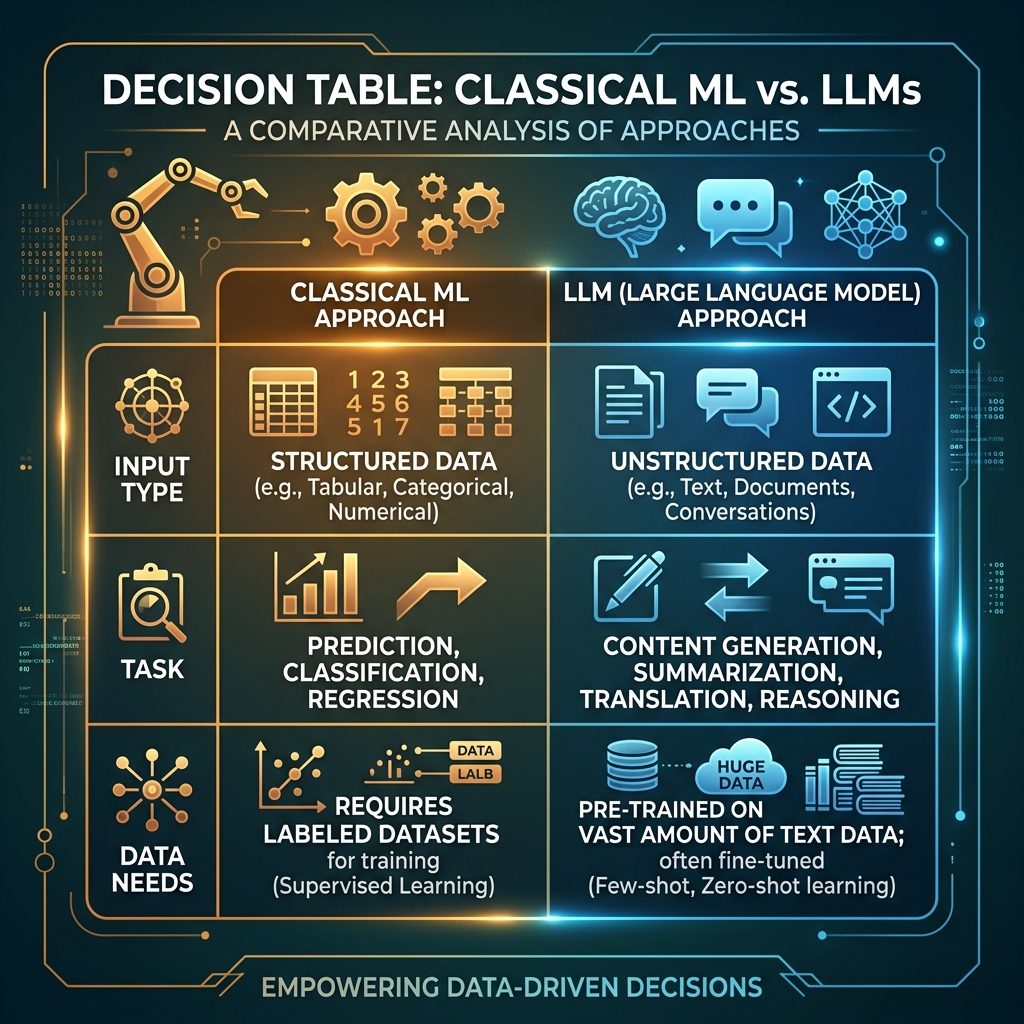
The most capable AI systems combine both — a classical ML layer for structured predictions (this customer is 78% likely to churn) feeding an LLM layer that generates a contextually appropriate response or action based on that prediction. The stack is complementary, not competitive.
The Data Reality Check (Have This Conversation Before Writing Code)
Every ML project runs into the data problem. It's never where people think it is.
Teams usually assume the data problem is volume — "we don't have enough data." This is occasionally true (for very complex deep learning tasks), but it's not the common failure mode. The common failure mode is data quality: the data is there, but it's dirty, inconsistently labeled, missing key fields, or stored in a schema that makes extraction expensive.
Before scoping any ML project, ask these questions:
Do we have labeled historical outcomes? If you're building a churn model, do you have records of which customers churned and when? If you're building a fraud model, do you have confirmed fraud cases tagged? Historical outcomes are the training signal. Without them, you're not doing supervised learning — you're doing something more experimental and more expensive.
How far back does the data go? Twelve months is usually the minimum for seasonal patterns to be learnable. Two to three years is better. If your data is six months old, your model may have no concept of seasonality, economic cycles, or market shifts.
Is the data complete? Missing values in key features are manageable. Missing values in the target variable aren't. Know before you commit.
Is the data representative of future conditions? A fraud model trained on 2022 data will see different attack patterns than 2026 fraud. A churn model trained on pre-pandemic behavior may perform poorly post-pandemic. Data drift is real, and it means models need retraining, not just deployment.
The Five Stages of a Production ML Pipeline
A model that lives in a Jupyter notebook is a science project. A model that lives in your product is a product. The difference is the pipeline around it. Here's what that pipeline looks like in practice:
Stage 1: Data. Collection, cleaning, labeling, validation, and versioning. This is where the project either starts well or sets up its own failure. Good data engineering here means your model is trained on what you think it's trained on, and that you can reproduce results if you re-run training tomorrow. Data versioning (DVC, Delta Lake, or similar) is not optional for production systems.
Stage 2: Feature Engineering. Transforming raw data into the inputs your model will learn from. For tabular data, this means handling missing values, encoding categoricals, creating interaction terms, normalizing distributions, and building the feature store that makes your features reusable across models. Feature engineering often has more impact on final model performance than model selection does.
Stage 3: Training and Experimentation. This is the part most people think is ML development — it's actually about 20% of it. Training multiple candidate models, hyperparameter search, cross-validation, tracking experiments with MLflow or Weights & Biases. The goal isn't the best model on the training set; it's the model that generalizes best to production inputs.
Stage 4: Evaluation. Holdout test set performance, bias analysis, fairness checks, comparison against baseline (usually "do nothing" or "current rule-based system"). Every model needs a threshold gate — a minimum performance bar that must be cleared before the model is considered for deployment. This gate is non-negotiable and defined before training starts, not after.
Stage 5: MLOps — Deployment and Monitoring. The model goes behind an API. Traffic gets routed through it. Predictions get logged. Model performance gets monitored in production (because production data drifts from training data over time). Retraining pipelines run on a schedule or trigger automatically when drift is detected. This is where ML systems go from fragile to durable.
The MLOps Layer Nobody Plans For (Until It Breaks)
Most teams plan for training. Very few plan adequately for what happens after training.
Models in production face a problem that doesn't exist in development: data drift. The statistical distribution of your inputs in January is not the same as in July. User behavior changes. Market conditions shift. Fraud patterns evolve. The model that achieved 92% accuracy in development will quietly degrade to 78%, then 70%, without any code change — just because the world it's predicting has shifted away from the world it was trained on.
The MLOps layer addresses this by: logging all predictions with timestamps, monitoring input distribution vs. training distribution (feature drift), monitoring prediction distribution vs. historical baseline (prediction drift), alerting when drift exceeds defined thresholds, and triggering retraining pipelines automatically when performance degrades.
This isn't a nice-to-have. A model without monitoring is a liability you don't know you have. It'll keep making predictions that look right on the surface while slowly being wrong in ways that are hard to catch without explicit tooling.
When Classical ML Still Wins Over LLMs
Three scenarios where you should reach for classical ML over an LLM, even in 2026:
When latency is critical. A gradient-boosted tree inference runs in milliseconds. An LLM call runs in hundreds of milliseconds to seconds. Real-time fraud detection on payment transactions, risk scoring at the moment of application, live ad bidding — these require latencies that LLMs fundamentally can't match for the foreseeable future.
When you need explainability. Regulated industries (banking, insurance, healthcare) often require that predictions come with explanations — why did we decline this loan, why is this claim flagged? SHAP values, feature importance, and decision trees provide this inherently. LLM "reasoning" is not a regulated explanation, at least not yet.
When your input is tabular and your output is a number or class. A neural network trained on 100 features and a hundred thousand labeled examples to predict customer lifetime value will outperform any LLM-based approach and cost a fraction to run at scale. The LLM has no structural advantage in this scenario — and a massive cost disadvantage.
How We Build ML Systems at Codewingz
We run a four-phase process for every ML engagement: discovery (data audit, use case validation, success metric definition), pipeline build (feature engineering, training, and evaluation), productionization (API, monitoring, alerting, and documentation), and iteration (scheduled retraining, performance reviews, and model improvements over time).
We're strict about one thing: we don't skip the data audit. Every engagement starts with a two-week sprint that produces an honest assessment of whether the data can support the model we're building. If it can't, we say so before any model code is written.
We use Python throughout (scikit-learn, XGBoost, LightGBM, TensorFlow/PyTorch where needed), MLflow for experiment tracking, and deploy on AWS SageMaker or equivalent cloud ML infrastructure. Everything ships with monitoring and a retraining plan — not just a model.
If you have a business problem that sounds like "predict X given Y historical data," that's a classic ML use case. Our ML development services are the right starting point for understanding whether it's buildable and what it'll take.
The Bottom Line
Machine learning development in 2026 isn't about chasing the frontier. It's about disciplined, pipeline-oriented work that turns the structured data your business already collects into predictive systems that generate compounding returns — lower churn, less fraud, better recommendations, sharper demand signals.
You don't need to be Google. You need good data, a focused use case, a proper pipeline, and an MLOps layer that keeps the model performing after it ships. Do those four things and machine learning stops being a research project and starts being a business asset.
The LLM era hasn't made that work less valuable. It's made combining both types of intelligence — classical ML for structured prediction, LLMs for language reasoning — the defining capability of serious AI teams in 2026.
Have a prediction problem? Let's look at your data.
We'll tell you in two weeks whether it's buildable and what kind of returns to expect.
Start with a Data Audit